Sexual Healthcare

  • Harsh Reality
  • Title X in Texas
  • Sex @ Tech
  • About

All-in-All: My Own Words

December 12, 2014 by Lucinda Holt Leave a Comment

The stories in this site are our findings. Please read discerningly as we strive to provide an unbiased recount of the situation that plagues the people of this state, especially those in this area.

On a cold sunny day in the spring of 2014, I was sitting in my car in a parking lot when my cellphone rang. The number on the screen showed the area code was from Washington, D.C., and I hesitated to answer. After a few seconds, I decided to pick it up, and I was glad I did. That call changed my career forever.

“Hello, is this Lucinda Holt?” The caller asked. He had a friendly, yet urgent-sounding tone.

I asked him to identify himself. He said he was Manny Fernandez with The New York Times and he needed help finding out where women in the Lubbock area go for abortion. He said I had 24 hours to submit my information. After I agreed to the assignment and hung up the phone, I went on a phone frenzy calling every clinic in this area.

In my research, I came across a woman who owned a local clinic and she said she felt they were being treated unjustly. After agreeing to an interview, the CEO invited me to her office where she gave a tearful testimony regarding her treatment.

Over the summer, I was offered a position with TheHub@TTU, and I delved into these documents devoting my time to research and statistics. In the fall, investigative reporter Jeff Bunnell came on board with the project. He too has immersed himself in the research of sexual health and family planning health care throughout the state.

While I have had the pleasure of covering many stories during my time at Texas Tech University, in my opinion this has been the hardest by a landslide.

The retrieval of documents and the politics involved in the health care system has opened my eyes.

For adequate health care, citizens should not have to be placed on the back burner due to agendas. The public places their well-being in the hands of medical professionals — for better and for worse — and behind the scenes, it’s incredibly cloudy. Anyone has access to information due to Federal and State information acts but as a trained individual, I was often dismissed — despite claims of transparency.

Citizens should be able to obtain information, especially when their lives and well-being are at stake. Once again, these are my words and own personal accounts.

As you read these stories and sift through the documents, make of this what you will.

Thank you.


Next: Clinical Calamity


Image Source

Filed Under: Harsh Reality, Top Feed

Clinical Calamity

December 12, 2014 by Lucinda Holt Leave a Comment

If Lubbockites need Title X-funded family planning services, the closest option is the South Plains Public Health District in Brownfield, a community — with a population of about 9,700 — approximately 40 miles southeast of here.

Despite Lubbock’s notoriously high sexually-transmitted disease and teenage pregnancy rate and population size of about 240,000, citizens do not see a single cent of Title X funding, and the answers from those behind the scenes are vague.

Fran Hagerty, the CEO of Women’s Health and Family Planning Association of Texas, said a falling out occurred with Generation Healthcare after its CEO, Merinda Condra, assumed the former Planned Parenthood of Lubbock. Condra said a dispute over Title X funds, which are solely distributed by WHFPT, have led her to repeatedly threaten legal action against Hagerty.

MirandaCondra
Merinda Condra

Condra sat at a long table with her mother and dog by her side for support. Tears filled her eyes as she recounted the timeline of the creation of Generation Healthcare and the beginning stages of its closure.

“The left torpedoed Title X funding because we disaffiliated from Planned Parenthood,” Condra said. “The right is going to because the entity used to be Planned Parenthood. In between are the women of this area who will be denied services.”

Title X funds are federal funds granted to clinics to make it possible to provide affordable sexual health care and family planning services to people who meet the requirements.

In Spring 2013, Women’s Health and Family Planning Association of Texas won the $13 million grant — originally $14.5 million — taking Title X away from the Texas Department of Health and procuring funds for Planned Parenthood and other clinics.

In Lubbock, though, preventive care for low-income women and men has been another casualty in this battle. Generation Healthcare, a family planning clinic that dissociated itself from Planned Parenthood after taking over what was formerly the only abortion provider in Lubbock, is going up for sale.

The clinic has struggled financially ever since it renamed itself and severed ties with Planned Parenthood programs across the state. Form 990s obtained from the organization show net assets plunged from 2012 to 2013 — from more than $800,000 to less than $500,000. The documents also reflect revenue has plummeted from over a million dollars to about $200,000 between those two years. In 2013, however, revenue has dropped to $131,000 with a deficit of about $104,000 after its operational costs.

The remodeled brown clinic in South Central Lubbock stood empty with a large blue and white “For Sale” sign on the street side of the property. The parking lot was empty, but that didn’t deter women from stopping by and asking if the clinic was open.

Condra pulled up in her personal vehicle and stepped out when a woman waiting in a small, black car asked about being seen; she said it was urgent. Condra held a brief conversation with her, and the woman got back into her car and drove away.

Fran Hagerty, the CEO of Women’s Health and Family Planning Association of Texas, said she has had a dispute with what used to be Planned Parenthood of Lubbock, which was renamed Generation Healthcare and is currently run by a new CEO, Merinda Condra. Since the takeover in October of 2013, a dispute over Title X funds solely distributed by WHFPT have even led Condra to repeatedly threaten legal action against Hagerty, she said.

The Emails

A month before the disaffiliation and the United States Court of Appeals for the Fifth Circuit’s decision to uphold tightened abortion clinic standards, Planned Parenthood of Lubbock began to solicit Hagerty for Title X funds. Two weeks after contacting them, an email transcript obtained by Hub@TTU reporters showed the clinic looked like it was going to become a provider in the state’s Title X network.

“Once you have looked them [policies and procedures] over and made the final determination to join us, we might want to hold a conference call with your staff and mine to answer questions and gather the information we will need to submit a ‘Change of Scope’ application to the Office of Population Affairs (OPA) to get approval to include you in our network”, said Hagerty to Tara Haskell, the then President-CEO of Planned Parenthood of Lubbock. “Together, I know we can make this happen!”

Hagerty got word from her chief financial officer that things were starting to change around the Lubbock clinic after the board of directors met. She said in the email she didn’t want to waste any time in submitting the change of scope approval and including them if OPA approved.

“We are so excited to have you, Tara,” Hagerty said in the email, “and want nothing more than to support you in the vital work you do for the community,”

“We are thinking of changing our name but still want to be involved with Title X, especially as there are no Title X providers in this neck of the woods,” Haskell replied.

[youtube http://www.youtube.com/watch?v=M1TKKV3KEiQ&w=420&h=315]

Haskell added that the tax ID number would remain the same, and Hagerty said that decision would have no affect on the clinic’s Title X status. When October came, the clinic’s name and ownership changed and so did WHFPT’s decisions.

Severed Ties

A little over a week later, the name change was implemented, and Generation Healthcare severed all connections with Planned Parenthood of Lubbock. Some of the original board members remained, including Haskell, and when the application was making precarious progress, Condra called Fran to ask her about its status.

“When I asked if every organization that changed its name was required to reapply as a new entity, you asked if I thought that was our situation,” Condra said in a follow-up letter to Hagerty, “When I stated that it was, you responded, ‘So, you are still a Planned Parenthood affiliate?’ To which I responded ‘no.’ You stated, our organization ‘agreed to work with a Planned Parenthood affiliate.’ When I asked if every organization that disaffiliated with Planned Parenthood was going to be denied funding and forced to reapply as a new organization, you stated ‘yes.’”

A clinic representative in Hidalgo County, in Texas’ Rio Grande Valley, had a different story to tell.

“As far as the Title X funds, we didn’t have to reapply whatsoever,” said Kathryn Hern, the community services director of Access Esperanza’s Hidalgo County clinics, formerly known as a Planned Parenthood affiliate. “We just had to let them know of the name change.”

The only difference between Hern’s situation and Condra’s, is that  Access Esperanza’s Hidalgo County clinics were already Title X clinics when the organization operated as a Planned Parenthood affiliate, unlike Planned Parenthood of Lubbock.

The letter showed Hagerty told Condra she did not know Generation Healthcare, even though Condra maintained it is the same legal entity: same services, same Medicaid number, same charter number and same tax ID number. Hub@TTU reporters obtained records verifying Condra’s statement.

For Condra, she said she felt the deal breaker was the decision to not associate itself with Planned Parenthood, the most widely known recipient of WHFPT’s Title X funds.

The letter also shows Condra pressed for specifications of recipient qualifications for clinics after Hagerty had stated WHFPT doesn’t have to give funds to anyone short of their standards.

According to her letter, Hagerty admitted there were none.

Condra had said that was odd for an organization with an instrumental role in Texans’ sexual health.

“We are simply trying to provide desperately needed services to the women of this area,” she said. “We have no interest in playing politics with women’s lives. Any attempts by your organization to withhold Title X funds to dissuade entities from disaffiliating or to punish organizations which have disaffiliated from Planned Parenthood is wholly improper and a violation of both state and federal law.”

On top of the setback that occurred after the takeover, Condra said she had also been denied funds because she was not referring patients to abortion clinics but providing counseling and adoption information as an alternative. She said this compelled Planned Parenthood to cancel them by delaying her clinic’s application process.

Truth Be Told

Carolena Cogdill, Title X recipient and CEO of Haven Health Clinic, said her clinic provides patients with several options, including adoption, but abortion referrals are barred from Title X funded clinics.

“We don’t refer anybody anywhere,” she said, “and neither does any other Title X clinic.”

Bell County Public Health District in Temple, Texas, second Cogdill’s statements. However, South Plains Public Health District does things differently.

Soronya Shafer, director of nurses at the South Plains Public Health District, said she does give abortion referrals to clinics with patients in need. Under federal law, a clinic may issue a referral if the patient’s life is in danger either due to a form of violence or illness.

A contract with WHFPT does reflect an unbiased approach to counseling pregnant patients, which would include abortion information, but the contract was signed by Tara Haskell, former CEO of Planned Parenthood of Lubbock. Whether or not Generation Healthcare assumes this responsibility, which Condra said she doesn’t, was not explicitly stated in the contract.

The contract was presented to Condra, and she said she had never seen it before.

Hagerty said it was inaccurate to say the setback happened because there was a disagreement over Generation Healthcare as a new entity. The reason the entity was denied funding, she said, was because she didn’t see an increase in Title X funding. Furthermore, she said, the paucity of Title X funds in the first place doesn’t give her the flexibility to divide the money even more.

Condra said $150,000 was already reserved for Planned Parenthood of Lubbock prior to the name change, when Hagerty knew the board of directors.

She said this has led her to believe funding was denied because of her dissenting views.
When asked to elaborate on the fight with Condra, Hagerty said she could not disregard her lawyer’s advice by talking about it. Condra said she does not plan on bringing any legal action against Hagerty and plans to focus on her latest project — turning the abortion clinic into an educational center for children dealing with learning differences.

GenerationClinic

The Generation Healthcare Facebook page shows its profile picture as a white square with bold red letters displaying the words, “CLOSING DOWN.”

Condra sat at a rustic-style wooden table as her mother sat looking on while petting their small dog. At times, a pause would give her a chance to compose herself as tears continued to fill her eyes.

After the dust has settled over this, Condra said she remains optimistic of the future but laments her cause being subverted by political polarization. She said while everyone involved should be more concerned with taking care of women, that is not what she has experienced.

She said this has been a trying year as they have spent the better part of it fighting to keep their doors open to help serve women in the Lubbock area.

“There are women hurting and their children hurting,” she said, her mother staring at her as her words slowed and softened, “and we have people playing politics back and forth.

The clinic was approved for funds under the Texas Women’s Health program which provides the clinic with about $5,000 a month. She said they were awaiting to hear about their request for expanded primary health care, which is more broadly based by providing services for women who are not necessarily of reproductive age. She said funds are crucial because most of the women who go to her clinic do not qualify for Medicaid.

She called the actions of the OPA and WHFPT impermissible, abusive, and possibly actionable under Texas law.

“Do we want to spend our time fight or do we want to spend our time helping?” A visibly upset Condra asked. “We all have a limited number of years on this Earth, and we have limited hours in each day. And, for me and my organization, a successful life is one that makes this world better. We have to measure how we’re going to spend those hours, how we’re gonna spend those years to make the world a better place.”


Previous: All-in-All: My Own Words                                                                                                                                                                                   Next: An About-Face with Title X Funds

Filed Under: Generation Healthcare, Harsh Reality, Top Feed

An About-Face with Title X Funds

December 12, 2014 by Lucinda Holt Leave a Comment

When Merinda Condra was denied Title X funding for her reproductive health clinic, she was told there were existing clinics in this region receiving these funds. Although this is true, conflicting reports cloud the truth.

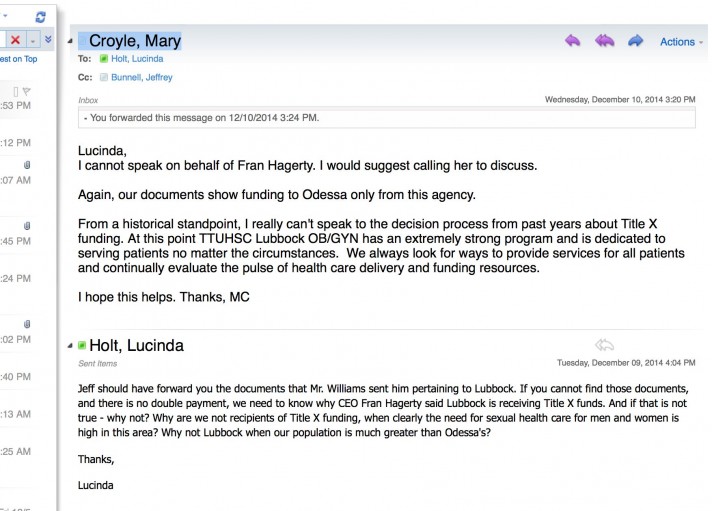
Response from TTUHSC - Lubbock
Response from TTUHSC – Lubbock

Condra, CEO of Generation Healthcare, said after a long messy battle over funding, she is closing the doors to her clinic. Unfortunately, women in this area are going to feel the effects of another casualty in the state’s reproductive health care war.


[soundcloud url=”https://api.soundcloud.com/tracks/181022616″]

She said as she was delivering adoption literature in 2012 when the Planned Parenthood staff approached her. In discussion, she said, she was told they were looking to change; she wanted to help. In the Fall 2013, Planned Parenthood of Lubbock became Generation Healthcare with Condra holding the reigns.

“The intent was to take the whole Planned Parenthood abortion debate and politics out of that clinic,” Condra said, “and make it just about helping women.”

Condra said the denial of funds came as a shock to her because she felt confident about the change — including the Title X application. The distribution of funds is the sole responsibility of Women’s Health and Family Planning Association of Texas and CEO Fran Hagerty.

[soundcloud url=”https://api.soundcloud.com/tracks/181128886″]

WHFPT was neglecting her communication efforts after steady correspondence between the agencies, she said. Once denied, Condra sought answers, and in a final effort, she wrote a letter to Senator John Cornyn.

The letter justified Hagerty’s decision by stating there are five existing Title X clinics in public health region 1. The WHFPT website shows four, and a representative for the United States Department of Health and Human Services said there are only three within this region.

When asked about the clinics and the funding, a representative with Cornyn’s office said that was a figure given to them from HHS. Office of the Assistant Secretary for Health representative Diane Gianelli said her records indicated three clinics, none of which are located in Lubbock County.

When asked for a further explanation, Gianelli said she would contact the Office of Population Affairs. Their response never came.

Carolena Cogdill, CEO of Title X-funded Haven Health Clinic in Amarillo, Texas, said she is surprised clinics in Lubbock are not receiving funds.

“It’s absolutely critical for women in the state of Texas to get complete care,” she said as she explained the strict requirements women need to meet in order to receive care under the Texas Women’s Health program.

Texas Women’s Health program, Cogdill said, covers women of reproductive age, and to apply, women need to provide proof of Texas residency.

About 40 minutes away, citizens of Brownfield can drive to the South Plains Public Health District clinic. As a Title X provider, this clinic can see both men and women, but funds are limited as they are distributed based on the clinical needs of the county.

Based on information received through various Title X websites, Lubbock residents are limited when it comes to reproductive health care. The drive to the smaller community seems to be encouraged and may be essential in dire cases.

Soronya Shafer, director of nurses for the South Plains Public Health District, said their Title X funds cover four different locations, but only one is located in public health region 1.

“The Title X is a little more inclusive as far as eligibility guidelines for clients, so it’s valuable to us because of that,” she said as she stressed the importance of Title X funding for the four locations she oversees.

She said Title X differs from state reproductive health funds because it covers teenagers as well as men.

Why not Lubbock?

With Title X playing such a vital role in the state’s reproductive health care, Lubbock County, an area notorious for high rates of sexuallly transmitted diseases and unplanned pregnancies, is without Title X-funded clinics.

Fran Hagerty, CEO of WHFPT, refused to comment on the situation between her and Generation Healthcare and the number of applicants out of the Lubbock region. However, she said Title X funds are coming into Lubbock.

[soundcloud url=”https://api.soundcloud.com/tracks/181034753″]

Documents obtained by Hub@TTU reporters showed Title X funding was indeed distributed to this area. When asked, Hagerty confirmed the Texas Tech University Health Sciences Center as the only agency in Lubbock that receives funding through her organization.

“To give you a sense of that in comparison to other places in the state,” she said, “our office is located in Austin, which is a much bigger community than Lubbock, and we only have one Title X provider in Austin as well.”

Hagerty said her organization has an established set of providers who receive funding, but documents showed she was ready to provide funds to Planned Parenthood before Condra took over.

Condra was not the only one denied Title X funds. Hagerty said WHFPT was unable to bring on new providers until the association is granted more money by the federal government.

“We are not going to take money away from them (existing providers) and from the wonderful work that they have,” she said, “to bring new providers on.”

[soundcloud url=”https://api.soundcloud.com/tracks/181025165″]

State of Confusion

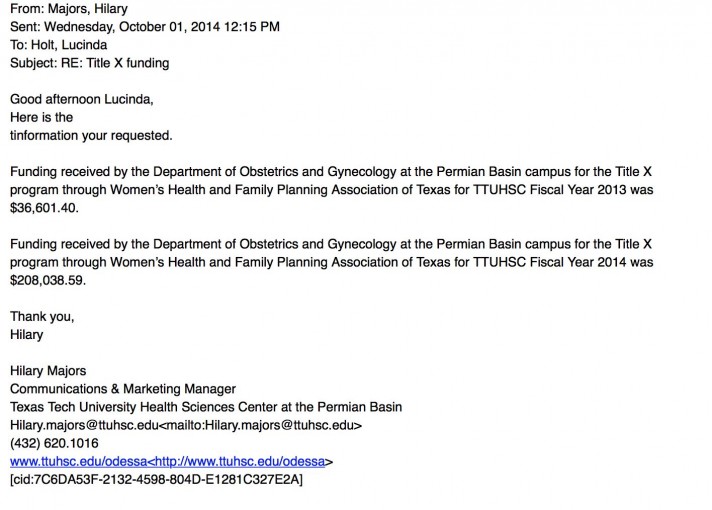
Email Response from TTUHSC Permian Basin

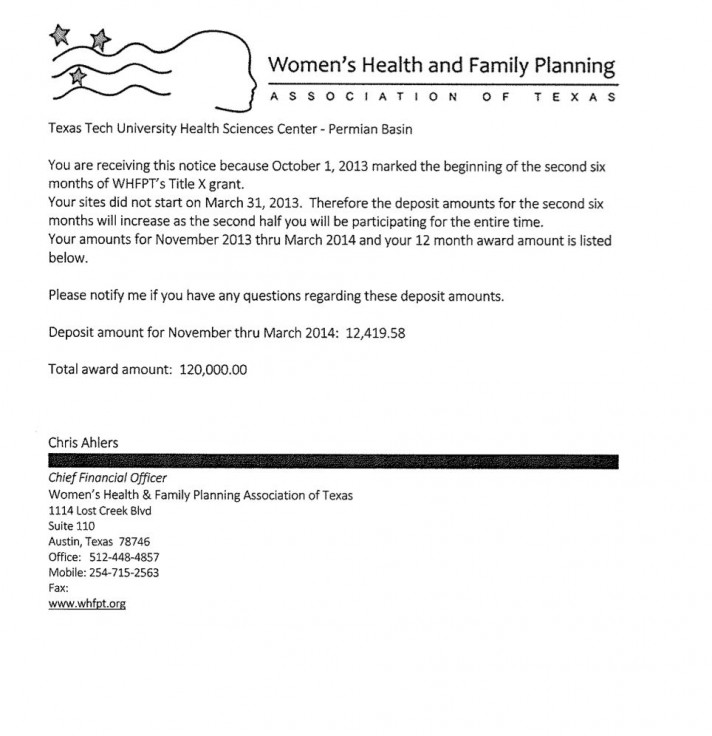
Representatives for the Texas Tech University Health Sciences Center-Permian Basin campus in Odessa, Texas, said the regional campus receives funding through WHFPT. Several government websites show the Permian Basin campus as an active provider, unlike the Lubbock campus.

Hilary Majors, a representative for the Health Sciences Center-Permian Basin, said the Department of Obstetrics and Gynecology received more than $36,000 during the 2013 cycle and more than $208,000 in 2014.

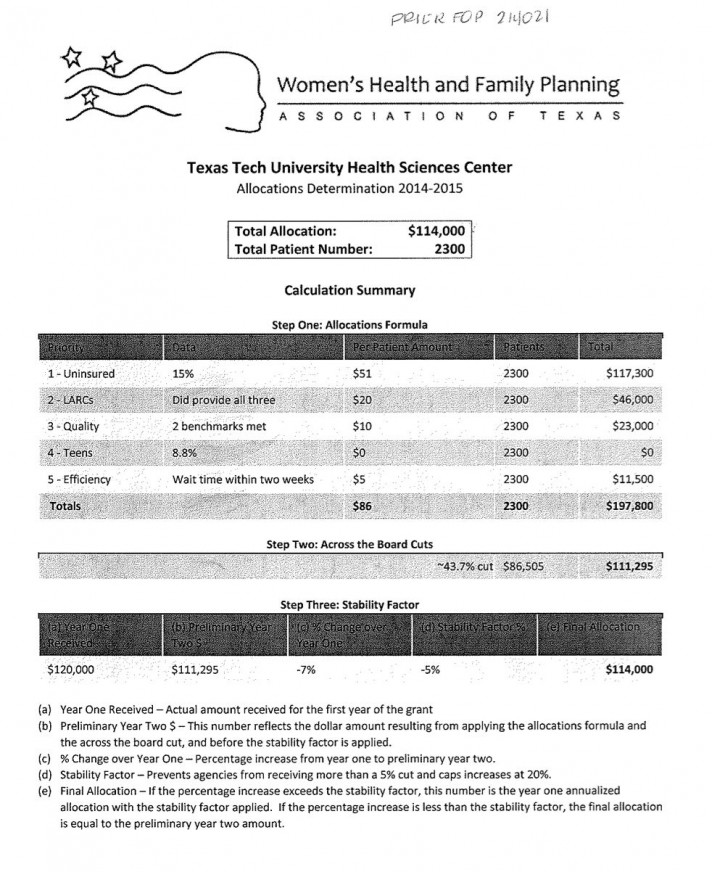
According to a budgetary document received from a representative of the Health Sciences Center in Lubbock, they receive more than $158,000 in Title X funds. Mike Crowder, the vice president of business affairs at the Health Sciences Center, said the Lubbock location sees none of that money.

Lubbock representatives, including Crowder, claim the funds are distributed to the Permian Basin campus, but none of the documents delivered from Odessa reflect this statement.

In a last effort to obtain more information, a request was sent out to view the same type of financial documents the Permain Basin campus released, but the Health Sciences Center-Lubbock representative Kevin Williams said no such documents exist.

Executive Director of Communications and Marketing Mary Croyle said when it comes to the situation at hand, she could not speak for Fran Hagerty. She also said their obstetrics and gynecology department serves people regardless of the circumstance. However, when asked about their knowledge of Title X funds, the response was the same all across the board: no one knew about the grant.

The Hub reporters were told by various Health Sciences Center officials that the Texas Women’s Health Program was used in Lubbock. According to the program’s guidelines, the program is predominately for women of reproductive age. Condra states Title X funds serve both men and women.


The Health Sciences Center’s Mike Crowder said he contacted WHFPT after being interviewed and was told the Health Sciences Center’s Lubbock campus does not receive Title X grant funds.

WHFPT CEO Hagerty’s response claims otherwise.

Official Title X Document from Permian Basin
Second Part of Title X Document - Permian Basin
Second Part of Title X Document – Permian Basin

Condra sat behind her desk and accessed the Office of Population website. As she explained Lubbock’s lack of funding, she typed in “Lubbock” in the Title X clinic search field.

“Look,” she said as she pointed to the screen. “There are none in this area. Now watch this.”

She expanded the search radius to 10 miles, and being unsuccessful, she moved up to 25 miles; nothing showed up. She finally broadened the search to a 50-mile radius, and Brownfield appeared on the map.

Condra said she knew the Health Sciences Center-Odessa received funds, but she wasn’t sure where the five clinics within public health region 1 are located, even though Senator Cornyn’s office representatives claimed they exist.

Although the clinic was something Condra had her sights set on, she said political biases are everywhere and it does not make sense to her

“Go ahead and fight about the other things,” she said, “but let’s get together and help these women,” she said. “Surely, we can agree on that.”


Previous: Clinical Calamity                                                                                                                                                                                                                  Next:  What are Title X Funds?

Filed Under: Generation Healthcare, Harsh Reality, Top Feed

What are Title X funds?

November 18, 2014 by Lucinda Holt Leave a Comment

“An ounce of prevention is worth a pound of cure”
-Benjamin Franklin

American politicians like to think their policies have ideological roots in the Founding Fathers’ wisdom. Back in 1970, President Richard Nixon passed what was known as the Title X Family Planning Program, a bill supported by the vast majority of Congress, with the goal of ensuring counseling and contraceptive coverage for low-income, uninsured Americans. After signing it, Nixon said, “The bill before me today, the ‘Family Planning Services and Population Research Act of 1970,’ completes the legislation I requested in my message on population. This measure provides for expanded research, training of manpower, and increased family planning services. In addition, it provides for the development of family planning and population growth information and education.”

Forty-four years later, Title X funding reduces the cost burden of family planning services for about 4.8 million Americans, according to the most recent 2012 Family Planning Annual Report from the Office of Public Affairs. The logic behind the law is to prevent unintended pregnancies for destitute adults, which should give them more control of their sexual well-being. According to the report, more than nine out 10 users were women; 71 percent had family income levels below the $23,050 poverty threshold. Sixty-four percent were uninsured, and 49 percent were under 25 years old. Men, of course, are not excluded from the services offered. They can get tested for STDs — a useful service with Lubbock having the 17th highest syphilis rate in Texas — and seek out sexual health counseling.

The contraceptive services end at contraceptive education, but the program has nonetheless been conflated with the abortion battle being waged in the state. This is mainly due to the fact Planned Parenthood affiliates, offering family planning services along with abortions, receive funding from the program. Even though Title X has become targeted in recent years, its services actually are designed to prevent abortions from happening through preventive care.

An August 2014 study by the Guttmacher Institute found Title X clinics helped prevent 1.1 million unintended pregnancies in 2012, which would have led to about 527,000 unintended births and 363,000 abortions. It also turns out these clinics save government spending as well; another key finding in the study was publicly funded clinics saved the federal and state governments about $7.6 billion in 2010 — with Title X services accounting for $5.6 billion of it.

With Title X funds facing budget cuts a few years ago and Planned Parenthood of Texas facing political fallout from the state’s stance on abortion, state health groups applied for the Title X federal grant in 2012 to control the money.

In 2013, Women’s Health and Family Planning Association of Texas became the voice of Title X for the state.
Fran Hagerty, the agency’s CEO, signs off on her email’s with a quote from a speech delivered to Congress by former President Nixon in 1969.

“It is my view that no American woman should be denied access to family planning assistance because of her economic condition.”


Previous: An About-Face with Title X Funds                                                                                                                                                                                                       Next:Abortion Clinics

Filed Under: Generation Healthcare, Title X in Texas, Top Feed

Abortion Clinics

November 10, 2014 by Lucinda Holt Leave a Comment

Abortion clinics may be a thing of the past for the Lubbock area, but the issue is still alive. With House Bill 2 in full swing, women are struggling trying to obtain reproductive services; the women in this area are no exception.

The restrictions implemented by HB2 has closed the majority of abortion clinics in Texas, including Planned Parenthood of Lubbock. Women in this region who are in search of these services are making five-hour trips to the nearest provider.

Administrative nurse, Gloria Martinez, said Hilltop Women’s Reproductive Clinic in El Paso, Texas, was referring patients to its New Mexico clinic while its abortion services were on hold and women are suffering at the hands of lawmakers. As El Paso’s sole abortion provider, the clinic is back in service after the U.S. Supreme Court intervened in the closures by placing HB2’s provisions on hold.

“They’re being denied rights previously granted to them by the federal government,” Martinez said, “and our community is fortunate to have the women’s reproductive clinic in Santa Teresa — which is only seven miles from El Paso — whereas many other communities aren’t as fortunate.”

She said the staff includes board certified doctors who do not perform abortions past 15 weeks. While that option is available, she said, the decisions that have been made regarding this topic are a major infringement on women’s rights.

“I say this is intervening in something that is very personal. Our constitution has given us the right to make these personal decisions, and when it comes to women,” she said, “I feel like this is nothing the federal government should intervene in because they are stepping in and taking away our rights. Like I said, many women do this for different reasons, and what this decision is going to do for women is make them feel like second-class citizens.”

She said the need for this procedure is often personal for these people as they have even dealt with cases involving rape. She said regardless of their beliefs, they are strongly against women using this as a method of birth control.

The state legislature website shows HB2 places tougher restrictions on abortion procedures and clinic standards by banning termination of pregnancy after 20 weeks and mandating surgical centers within clinics.

The bill also indicates the doctor performing the abortion must have admitting privileges at a hospital within a 30-mile radius of the facility.

Tabitha Collier, sexual health advocate and Texas Tech University student, is an active voice on campus. As clinics reopen their doors across Texas, she said it was a good move on the Supreme Court’s behalf.

“I’m definitely for more places being open,” Collier said, “because even if they are against abortions for an unplanned pregnancy – like you actually got pregnant, you weren’t trying to – there’s abortions for medical reasons, and those may be matters of life or death.”


(Abortion Clinics In Texas)

She said the closures force women requiring a medically critical abortion to travel, as well. Scheduling conflicts, traveling distance, financial means and personal reasons, she said, may push individuals to dangerous alternatives.

Eric Finley, University Medical Center representative, said the center’s medical records do not indicate any self-induced abortion cases over the past year, but it has occurred in the past.

Collier said some women may find it difficult to seek help because of the moral issues surrounding this topic.

“I would hope they would have somebody that they could ask for help,” she said, “and if money is an issue, a lot of these people don’t want to ask their family or their friends for money because of the social stigma.”

She said she knows women who have faced this situation, but they were fortunate to have support.

Outside Holden Hall on a warm day, a young blonde woman sat independently while smoking a cigarette as leaves blew over the ground around her. Her accent was heavy as she explained this is her first month living in the U.S. While she enjoys her new home in Texas, she said, she finds the laws and morals regarding sexual health unusual.

Marine Marty is a 19-year-old student from Limoges, France. Marty said the one thing she has noticed is people have placed a taboo on sexuality, and that includes sexual education and health care.

“It’s so different here,” Marty said. “In France, we have access to abortion and to health system in general. We don’t have to pay for abortions, and it’s really nice because people and students are really aware of what they can do if it happens to them, and we have people in universities to help you and give you advice on how to practice abortion in an anonymous way.”

She said traveling for an abortion complicates the situation for women. For years, she said, women have struggled to have these rights, and now that there are restrictions, she said she feels society has regressed in regard toward women’s rights.

Nurse Martinez said, as of now, the El Paso clinic does not offer transportation to its sister clinic in New Mexico, but they are willing to look into that option to ease the burden for women who may find themselves in this situation.

She said she has seen the regression while on the border as residents from the neighboring city of Juarez, Mexico, come into her clinic, and her observation is Mexico is more progressive than Texas when it comes to abortion laws.

“In Mexico, women are progressing in this issue,” Martinez said. “In the United States, we are regressing.”


Previous: What are Title X Funds?                                                                                                                                                                                              Next: Sexual Health at Texas Tech


Feature Image Credit Tumblr

Filed Under: Abortion Clinics, Title X in Texas, Top Feed

Sexual Health at Texas Tech

November 9, 2014 by Lucinda Holt Leave a Comment

With limited resources on campus and throughout the city, Texas Tech University students are left trying to find affordable sexual health care while learning about the facts.

In 2013, Lubbock County was in the top 20 out of the 254 counties in Texas for the highest number of sexually transmitted disease cases as reflected by the Department of State Health Services’ annual report.

Lance
Lance Evangelister

New Orleans-native Lance Evangelister is a 20-year-old, pre-engineering major in his sophomore year. He said although his religious beliefs encourage him to abstain, he wouldn’t know where to obtain contraceptives if the situation presented itself.

“We don’t have enough; well I just haven’t seen it on campus, so I can’t say that they are. You just don’t see it. Are they even sold on campus? I don’t know,” Evangelister said when asked if condoms are easily accessible at Texas Tech.

He said protection is important if anyone is sexually active.

“They should definitely have condoms in the dorms,” he said. “Dude, you should have that. I was just talking to some girls earlier today, and she was talking about, ‘I don’t know if I can hold out for that long’ because she was asking me for advice about some guy.”

Among students, he said, he has heard sexually related stories, and what scares him most is how they openly talk about not using condoms.

“Along with AlcoholEdu,” he said, “there should definitely be something spoken about sex because AlcoholEdu is mandatory as freshman. Maybe we should do something about sex.”

The DSHS website shows Texas is currently under an abstinence-centered education program, which provides students with facts about the risks and prevention in hopes of delaying sexual activity.

In 2012, the city of Lubbock reported a total of 190 pregnancies within the 13- to 17-year-old age range, as shown by the statistical report for the DSHS.

The National Campaign to Prevent Teen and Unplanned Pregnancy website showed Texas had 44.4 pregnancies per 1,000 girls within the 15- to 19-year-old age range in 2012. The website also reflects approximately $1.1 billion was spent on teen childbearing.

Brian Carr, Ph.D, has served on the Lubbock Board of Health and within the Texas Tech InterFraternity Council, and he said sometimes education is not enough if it is not being talked about at home.

Condoms
Safe Sex

“I think the better fix to all this is we have to foster relationships, and the difficulty is,” Carr said, “whether it be at the junior high, high school or college level, is saying that we need older people to kind of mentor younger people. And, the trouble is, is that we pretty much just say, ‘let the schools do it,’ and then the schools basically tend to throw some pamphlets out there.”

He said the last sexual health seminar he attended by the state provided literature about self-esteem, consent, and scientific information about reproduction. While the literature was informative, he said, the real problem is people are not truly discussing the topic

While on the advisory board for the Texas Tech IFC, he said, he once proposed women’s restrooms should hold a bowl of condoms. This was a decision he felt was necessary; however, others disagreed.

The DSHS report also reflected about 2,500 STD cases reported in the city during 2013.

Marine Marty
Marine Marty

History major Marine Marty has been in Texas for about a month, and she said the people in her hometown of Limoges, France, view sexuality in a more progressive way than those in this area.

While she said she has seen condoms for sale in the Student Union Building, she thinks they should be spread out throughout campus along with counselors or advocates readily available to answer any sexual health questions without an appointment.

“We need to have common talk whenever we want, and I think that is important,” she said, “or even a phone number to call if someone has a problem.”

A representative with the Texas Tech Student Wellness Center said the facility does offer contraceptives and STD testing for a fee.

The Lubbock City Health Department website shows it offers free or low-cost STD testing for area-wide patients who qualify.

When it comes to restrictions on reproductive health care, Marine Marty said it won’t eliminate the issue of unplanned pregnancies. She said the only solution is to focus on prevention, and that includes giving people an outlet to speak about sexual issues freely.

She said placing a taboo on sexuality could lead to negative psychological effects.

“Prohibition is not the way to act,” Marty said, “and it is even more difficult when it is about health.”


Feature Image Credit: Source


Previous: Abortion Clinics

Filed Under: Healthcare at Texas Tech, Sex @ Tech, Top Feed

Hub%20logo

Facebook_Logo

twitter-icon

Copyright © 2026 · Agency Pro Theme on Genesis Framework · WordPress · Log in